Phase 1 Youth Movement Cohort
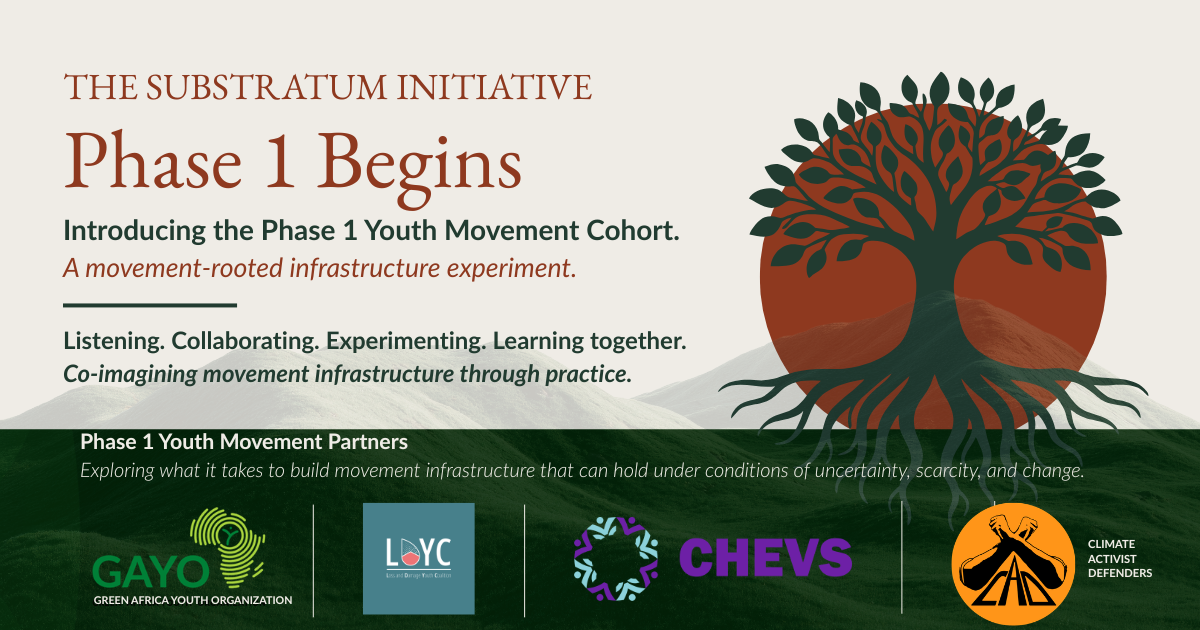
Over the past year, The Substratum Initiative has listened to youth-led movements: the pressures they carry, the organisational realities they navigate, and the questions that emerge when movements are expected to hold more with fewer resources.
In June 2026, we began Phase 1 of our Youth Movement Cohort, bringing together four youth-led movement partners in a shared process of organisational inquiry, experimentation and collective learning.
This is not a pre-designed programme or a predetermined infrastructure model. It is a space to explore which forms of organisational infrastructure can be strengthened, shared, federated, or collectively stewarded, and under what conditions these approaches become useful, ethical, participatory, and sustainable.
Through organisational inquiry, experimentation spaces and collective reflection, we are beginning to identify infrastructure priorities, examine existing practices and explore alternative approaches alongside movement partners.
This first phase is intentionally small. Our aim is not to maximise participation, but to make it meaningful, sustainable, and responsive to the realities youth-led movements already navigate. We expect assumptions to be challenged, approaches to change, and some experiments to reveal their limitations. These, too, are valuable forms of learning.
Our inaugural cohort brings together four youth-led movement partners working across climate justice, feminist organising, LGBTQIA+ rights and the protection of environmental and climate defenders.
Each organisation brings its own experience, knowledge systems, organisational realities and priorities. Together, we are exploring what it means to develop movement infrastructure through relationships, shared inquiry and experimentation rather than predetermined solutions.
Our Phase 1 Youth Movement Partners
Green Africa Youth Organisation (GAYO)
GAYO co-creates and implements climate solutions across Africa. Working across themes such as just transition, adaptation and resilience, zero-waste cities, and green jobs, we bridge communities, institutions, and policy to deliver locally owned and durable change. Their work is grounded in enabling young people to live, work, and lead within the systems they help transform.
Loss and Damage Youth Coalition (LDYC)
The Loss and Damage Youth Coalition is a global network of over 1,400 young negotiators, activists, researchers, storytellers, communicators, and trainers from more than 100 countries, united in pushing for ambitious international action on loss & damage (L&D).
CHEVS
CHEVS is a youth-led feminist collective advancing LGBTQI+ equality across Africa by building agency and power with diverse LGBTQI+ youths to shape their own future and boldly confront inequality across sectors. CHEVS’ work is achieved through movement building, advocacy and narrative change efforts, while building political power to achieve the liberation of its communities across the region.
Climate Activist Defenders (CAD)
Climate Activist Defenders (CAD) aims to protect the lives and well-being of front-line climate justice activists working under oppressive and dangerous conditions by providing emergency response and safety resources and by building a support network within the climate justice movement. CAD is currently operating globally to support climate justice activists, environmental human rights defenders and Indigenous defenders.
The Question We are Holding
Throughout Phase 1 (2026–2027), we are exploring one overarching question:
What forms of infrastructure can be shared, federated or collectively stewarded within youth-led movement ecosystems, and under what conditions?
Our initial shared area of experimentation is Monitoring, Evaluation, Accountability and Learning (MEAL).
More specifically, we are asking:
What becomes possible, and what must change, when monitoring, evaluation, accountability and learning are shaped by movement realities, knowledge systems and forms of accountability rather than donor requirements alone?
Our inquiry begins with relationships, trust, curiosity and shared stewardship. We recognise that meaningful experimentation requires the space to question assumptions, navigate differences and adapt approaches as we learn together.
Learning From Experimentation
Phase 1 is as much a process of inquiry as it is infrastructure development. Through conversations, experimentation spaces, and collective reflection, we are documenting emerging questions, tensions, adaptations, and insights into what it takes to strengthen movement infrastructure.
As the work develops, we will share selected reflections, practical resources, and learning from the cohort, while respecting our movement partners' ownership, confidentiality, and boundaries.
Explore our Practice & Inquiry → Soon!