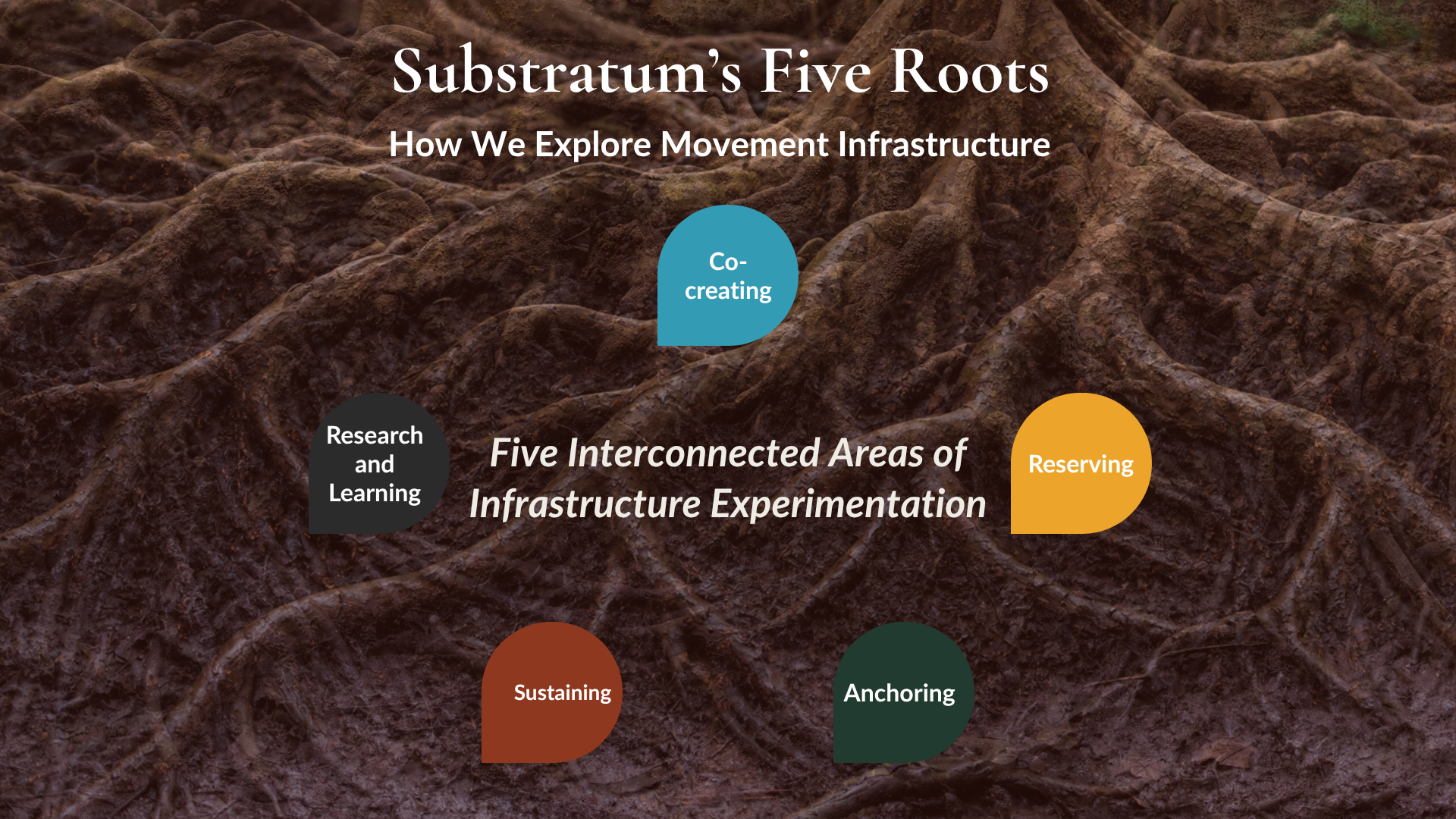
The Five Roots: Organising Our Experimentation
The Five Roots describe how Substratum currently organises its work across interconnected areas of experimentation, accompaniment and learning.
They are not separate programmes or predetermined solutions. Instead, they provide a strategic orientation for working alongside youth-led movements to strengthen organisational foundations, explore shared infrastructure and develop knowledge through practice.
As the work unfolds, these areas may evolve in response to emerging needs, opportunities and what we learn together.
-
Strengthening the organisational foundations that enable youth-led movements to navigate uncertainty and sustain their work. This includes organisational inquiry, accompaniment and targeted pro bono support responding to immediate infrastructure needs.
-
Exploring how alternative approaches to resourcing, collective stewardship and financial resilience might strengthen movement continuity. This area remains part of our strategic inquiry, with further experimentation to be developed as capacity and opportunities allow.
-
Working alongside youth-led movements to identify priorities, develop and test infrastructure approaches, and explore participatory models of governance, accountability and shared stewardship.
-
Exploring care, organisational culture, leadership accompaniment and transitions as integral to the infrastructure that enables movements to endure, adapt and sustain collective work over time.
-
Generating practice-based knowledge through research, documentation, collective reflection and learning. This includes inquiry into care as organisational infrastructure and sharing emerging insights and resources with the wider movement ecosystem.
Learning Across the Five Roots
The Five Roots are interconnected rather than self-contained. Organisational challenges rarely sit within a single area: governance questions are entangled with resources, operational capacity, relationships, and how knowledge is produced and shared.
Our experimentation therefore moves across these areas, responding to the realities of movement partners rather than following a fixed sequence of activities.
Through this work, we are building a body of practice-based knowledge about what helps movement infrastructure endure, where existing approaches fall short and what alternatives may be possible. We share this learning wherever appropriate, recognising that some knowledge and decisions must remain with the movements from which they emerge.