The Five Domains of Organisational Infrastructure
Understanding the interconnected foundations that enable movements to organise, adapt, and endure.
Organisational infrastructure is more than the systems that keep an organisation running. It encompasses the interconnected resources, operational foundations, governance arrangements, knowledge practices and relationships that shape how organisations function, make decisions, adapt and sustain collective work over time.
Our understanding of infrastructure builds on existing scholarship and practice, including infrastructure studies (Star & Ruhleder, 1996), which invite us to look beyond technical systems to the often-invisible organisational conditions that sustain collective action. We approach infrastructure not simply as operational support, but as something embedded in organisational relationships, arrangements and everyday practices.
Drawing on this scholarship, movement knowledge and our ongoing organisational inquiry alongside youth-led movements, Substratum proposes five interconnected domains of organisational infrastructure: Resource, Operational, Governance, Knowledge and Relational.
These domains offer a working analytical framework for examining where organisational capacities, pressures and possibilities intersect. They are not an exhaustive typology or a universal model. Rather, they are part of an evolving praxis through which theory, movement experience and experimentation inform one another, and through which we expect to question, test and refine our understanding over time.
Five Interconnected Domains
The financial resources, reserves, funding relationships and stewardship practices that shape an organisation's capacity to sustain its work, navigate uncertainty and make decisions about its future.

Resource Infrastructure

Operational Infrastructure
The people, human resource practices, policies, administrative systems and organisational processes that enable work to happen, responsibilities to be managed, and continuity to be maintained.

Governance Infrastructure
The structures and practices through which decisions are made, accountability is exercised, participation is enabled, and leadership and collective stewardship are negotiated.
The practices and systems through which knowledge is generated, documented, interpreted, retained and shared, including monitoring, evaluation, accountability and learning (MEAL), research, collective memory and movement-defined ways of knowing.

Knowledge Infrastructure

Relational Infrastructure
The relationships, trust, care, solidarity and organisational cultures that shape how people work together, navigate conflict, sustain participation and support collective resilience.
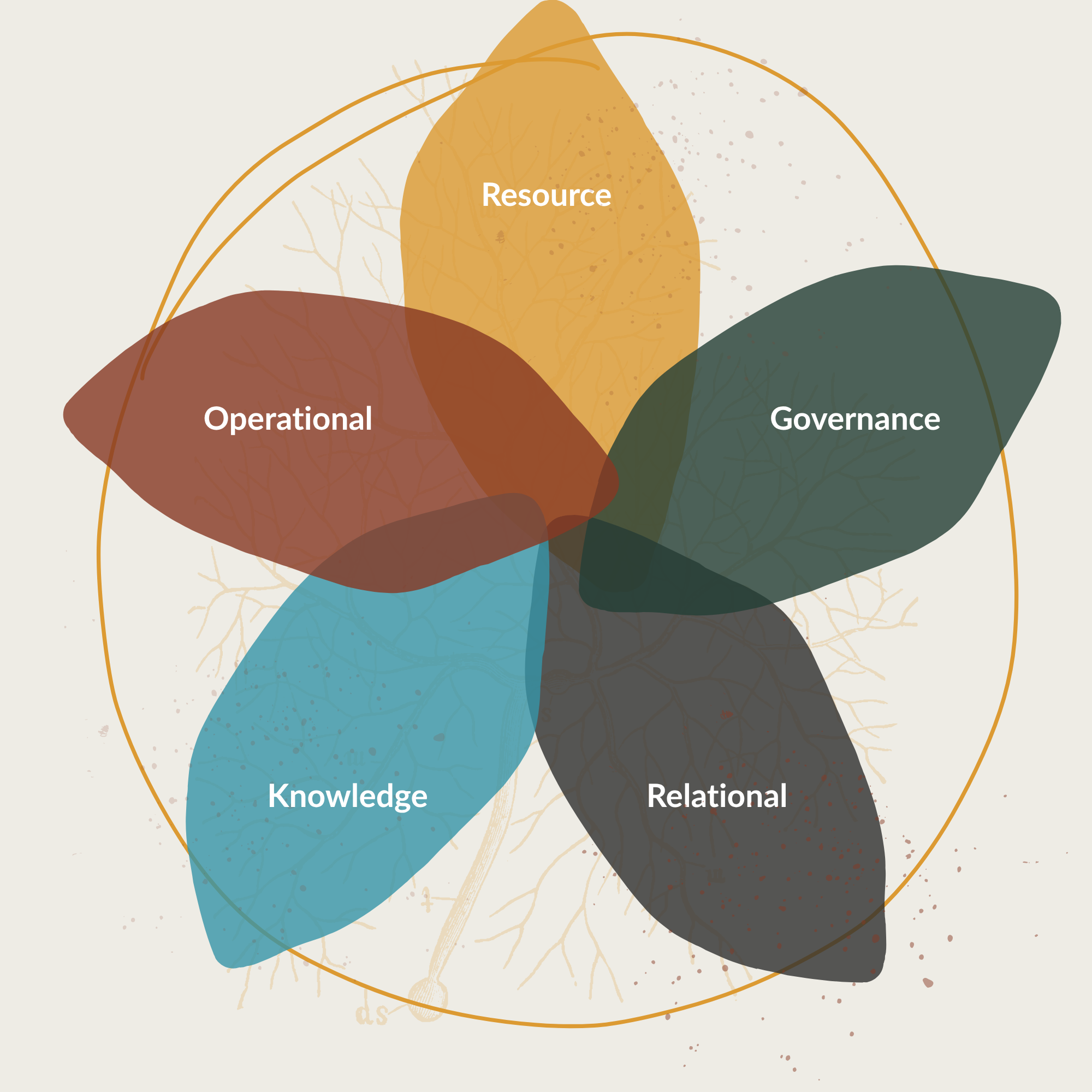
The five domains are interconnected.
Changes in one domain influence and are influenced by changes in other domains.

How the Five Domains Interrelate
The five domains are interconnected rather than separate. Organisational challenges and opportunities rarely sit within a single domain. For example, decisions about resources shape operational capacity, governance arrangements, knowledge practices, and the relationships that sustain collective work.
Care also operates across all five domains. It is not confined to relational infrastructure, but can shape how resources are stewarded, operations are organised, decisions are made, and knowledge is valued.
These arrangements are not neutral. They can enable participation, continuity and collective accountability, but they can also reproduce exclusion, obscure labour or shift responsibility onto those already carrying disproportionate burdens.
Examining these interconnections helps us understand organisational infrastructure as a dynamic, contested whole rather than a collection of isolated systems or functions.
From Framework to Praxis
The Five Domains of Organisational Infrastructure are not intended as a diagnostic checklist or a predetermined model for organisational development. They are a way of asking questions, examining assumptions and exploring how organisational infrastructure is experienced, negotiated and sustained within youth-led movements.
Our approach brings together existing theory, movement knowledge, organisational practice and collective experimentation. Through inquiry and accompaniment, we seek to understand how different domains interact, where pressures and possibilities emerge, and what forms of infrastructure might be strengthened, shared, federated or intentionally remain locally governed.
This is an iterative process. Practice and experimentation shape our understanding of infrastructure, while existing scholarship and critical reflection help us question assumptions, interpret what we learn, and identify new directions for experimentation.
Substratum's Five Roots describe how we currently organise our areas of work — Anchoring, Reserving, Co-creating, Sustaining, and Research & Learning. The Five Domains offer a complementary lens for understanding the organisational conditions and relationships we encounter through that work.
Neither framework is fixed. Both remain open to revision as our experimentation reveals new questions, contradictions, relationships and possibilities.
A Note on this Framework
The Five Domains are part of Substratum's ongoing practice-based inquiry into organisational infrastructure. Our thinking draws on infrastructure studies, critical organisational scholarship and the knowledge and practices of social movements, including Star and Ruhleder's (1996) work on infrastructure. The framework is provisional and will continue to develop through research, experimentation and collective learning.
Selected reference: Star, S. L., & Ruhleder, K. (1996). Steps toward an ecology of infrastructure: Design and access for large information spaces. Information Systems Research, 7(1), 111–134.